


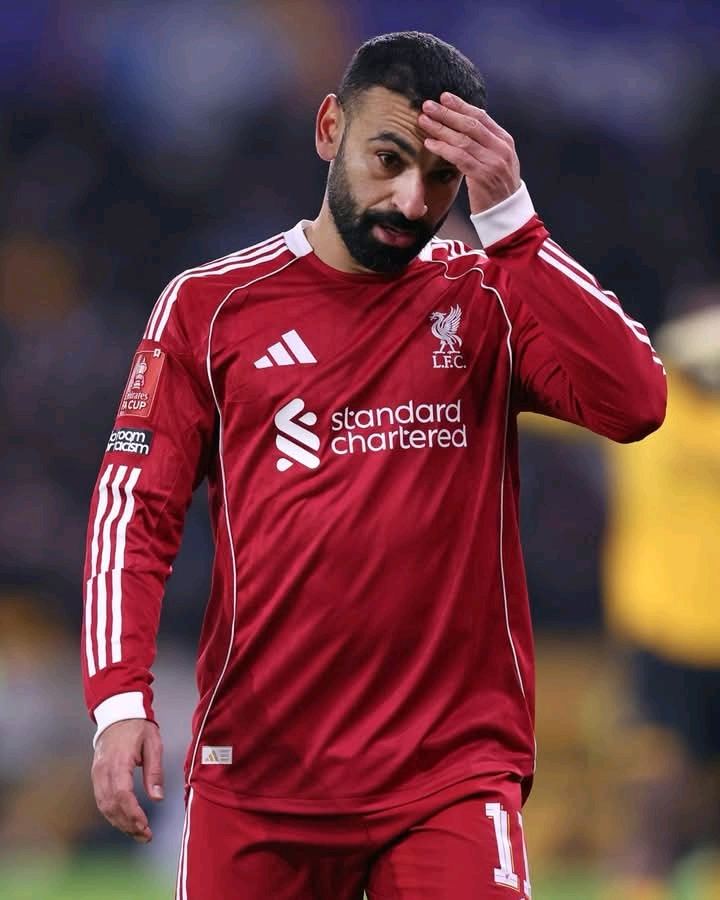
Mohamed Salah has established himself as one of Liverpool’s greatest players of all time. However, the Egyptian forward has struggled to reach his usual heights this season, sparking debates among fans and analysts. Some believe age could be a factor, while others point to tactical changes introduced by manager Arne Slot.
A closer look at the statistics helps explain the situation.
During the 2024-25 campaign, Salah delivered one of the finest individual seasons ever seen from a Liverpool player. At the age of 32, he silenced doubts about his longevity by scoring 34 goals and providing 23 assists in 52 appearances across all competitions. In the league alone, he produced 29 goals and 18 assists to guide Liverpool to the title.
That success came during Slot’s first season at Anfield and suggested the Dutch coach had found a system that perfectly suited the Egyptian star. Salah himself acknowledged this after Liverpool clinched the title at Anfield against Tottenham Hotspur. He explained that the tactical setup allowed him to conserve energy defensively and focus more on attacking contributions.
His outstanding performances earned him a two year contract extension. However, the current season has been far less productive. After 32 matches in all competitions in 2025-26, Salah has recorded only nine goals and eight assists. For most wingers those numbers would be acceptable, but for a player who has consistently produced elite statistics since joining Liverpool in 2017, the drop is striking.
The contrast with last season is particularly clear. Salah reached 17 goal involvements in just 16 matches in the previous campaign. By the time he had played 32 games in 2024-25, he had already contributed to 40 goals.
Initially, his partnership with Slot looked extremely promising. In their first 41 games together, Salah registered 32 goals and 22 assists. However, across the following 43 matches, those numbers dropped sharply to just 11 goals and nine assists.
Naturally, this decline has raised questions. Some observers believe age could be catching up with him, though that explanation seems overly simple considering his remarkable output just a year earlier. Others believe tactical changes may have played a role. In December, Slot surprisingly left Salah on the bench for several games. He even remained unused in a dramatic 3-3 draw against Leeds United.
Since then, relations between player and manager appear to have improved. Following his return from the Africa Cup of Nations in January, Salah regained his place in the starting lineup. He has managed four goals and four assists in 12 games since then, including goals in consecutive matches against Wolverhampton Wanderers during a 2-1 Premier League defeat and a 3-1 FA Cup victory.
Despite those flashes of improvement, his overall influence remains lower than usual. In a recent UEFA Champions League clash against Galatasaray S.K., Salah failed to register a single shot before being substituted in the 60th minute during a 1-0 defeat.
That match was still significant for another reason. It marked his 81st European appearance for Liverpool, allowing him to surpass the record previously held by Jamie Carragher.
Statistically, the downturn is clear. Salah is averaging only 0.24 non penalty goals per 90 minutes this season, the lowest figure of his Liverpool career. He is also attempting fewer shots, averaging 2.8 per match, another personal low since arriving at Anfield.
His finishing efficiency has declined as well. Only 10 percent of his non penalty shots have resulted in goals, the worst conversion rate he has recorded for the club. In addition, he is receiving the ball less frequently in dangerous areas. His touches inside the opposition penalty area have dropped to 7.5 per match compared with 9.6 last season.
This suggests he is operating further away from goal. Data from touch maps indicates that a smaller share of his touches now occur inside the penalty box, while more take place in deeper areas around it. Such positioning inevitably reduces his chances of scoring.
Interestingly, his creative contribution remains solid. Salah is averaging 0.28 assists per 90 minutes this season, which aligns with his expected assists numbers. He continues to create chances and contribute to attacking moves even if his scoring output has declined.
His dribbling has also become less effective. Although he still attempts more than three dribbles per match, his success rate has dropped to 27.8 percent, the lowest of his Liverpool career.
Opposition tactics could be another reason. Many teams are defending deeper against Liverpool this season. Low defensive blocks have become more common, leaving less space for Salah to exploit with his pace and direct running.
Defensive responsibilities may also be playing a role. Salah is making more tackles and interceptions this season than in most of his previous campaigns, suggesting he is contributing more work without the ball.
Ultimately, the issue does not appear to have a single explanation. Both tactical adjustments and individual performance seem to be contributing factors. Salah is receiving fewer high quality chances, but he is also finishing less effectively when opportunities arise.
Liverpool also strengthened their attack last summer by signing players such as Florian Wirtz, Hugo Ekitiké and Alexander Isak. The additions suggested the club wanted to reduce its dependence on Salah’s goal contributions. However, the sudden decline in his numbers has highlighted just how crucial he remains.
Another factor could be the changes behind him in defense. For years Salah benefited from the creative partnership with Trent Alexander-Arnold, whose precise deliveries from right back regularly created scoring opportunities. This season, Liverpool have used several players in that role, none of whom replicate Alexander Arnold’s unique attacking qualities.
If Liverpool hope to salvage their season by securing Champions League qualification or winning silverware, Slot may need to adjust his tactics to position Salah closer to goal again. At the same time, the Egyptian forward must rediscover the sharpness and confidence that once made him one of the most feared attackers in world football.
Upcoming matches against Tottenham Hotspur and Galatasaray S.K. could offer the perfect chance for him to regain his rhythm.
Should we send you latest update about your favourite sports and team?
Enter you email in the box below and hit the subscribe button to join our teaming 876+ sports community.


