


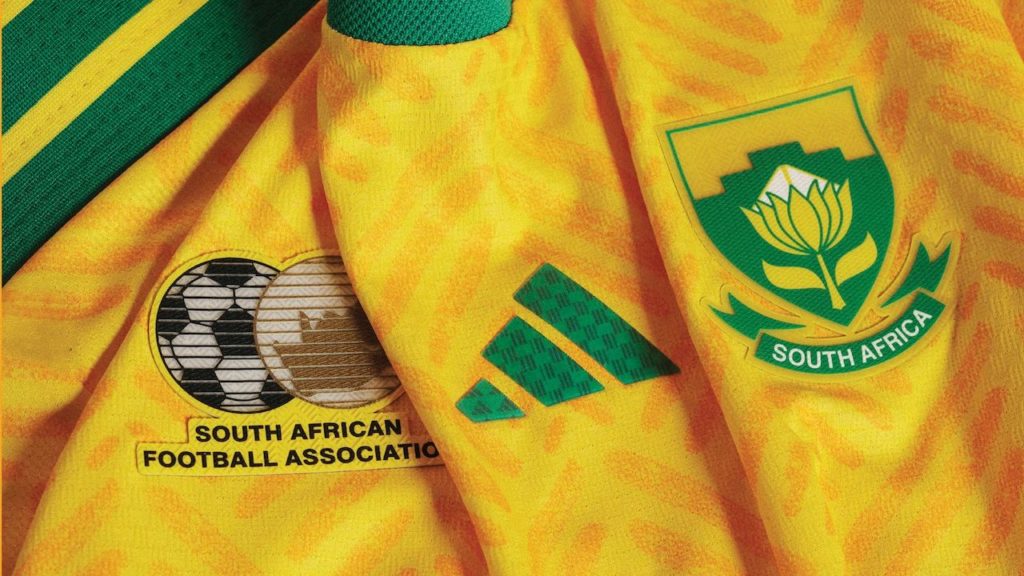
When South Africa step out at the 2026 World Cup opener against Mexico in Mexico City, one of the most distinctive details on their kit will be easy to notice immediately: two badges worn side by side on the chest.
It is a design choice that stands out in international football, but one that carries deep meaning rooted in South Africa’s sporting structure, national identity, and post apartheid history.
Two Badges, Two Meanings, One Identity
The presence of two badges on the South African national team jersey reflects the dual structure of governance and identity in South African sport.
On the right side of the chest sits the King Protea emblem, the national symbol of South African sport. It represents unity across all sporting codes in the country and is used by various national teams to reflect their connection to the broader South African sporting identity. In the post apartheid era, the Protea has become one of the most recognisable symbols of national cohesion, representing government recognised sport and a unified national direction.
On the left side of the shirt is the official badge of the South African Football Association SAFA, the governing body of football in the country. This emblem represents the sport specific authority that administers the national team, ensuring compliance with international football regulations while maintaining football’s own institutional identity.
Together, the two badges reflect a balance between national symbolism and sporting governance, one representing the country as a whole and the other representing football itself.
The Meaning of the Star Above the Badge
Above the SAFA crest sits a single star, a detail that carries its own historical weight.
The star commemorates South Africa’s victory at the 1996 Africa Cup of Nations, a landmark achievement that remains one of the defining moments in the nation’s football history. It serves as a permanent reminder of their continental triumph on home soil and is worn as a symbol of pride for that generation of players and supporters.
A Design Shaped by History and Politics
South Africa’s kit identity is also shaped by broader historical and political context.
Due to apartheid era isolation, South African sport was banned from FIFA competition from 1961 until 1992. As a result, their entire World Cup history exists in the modern era, beginning only after readmission to international football.
Since then, South Africa have appeared at the World Cup in 1998, 2002 and 2010, and now return for their fourth appearance in 2026.
Over time, regulations and sporting traditions in South Africa have encouraged the continued use of both national and association symbols on the kit. While some sports have shifted away from dual badge designs, football has retained both, preserving a visual identity that reflects both state and federation.
More Than a Kit A Symbol of Unity
The combination of the two badges has become more than just design. It represents the intersection of sport, politics and national identity in a country where football has often played a unifying role.
Worn together, the emblems reflect both institutional structure and shared pride, a visual reminder of how sport in South Africa has been used to bridge division and build collective identity.
As South Africa prepare to face Mexico in the opening match of the 2026 World Cup, those two badges will carry more than branding. They will carry history, memory and meaning stitched into every thread of the shirt.
Should we send you latest update about your favourite sports and team?
Enter you email in the box below and hit the subscribe button to join our teaming 876+ sports community.


