


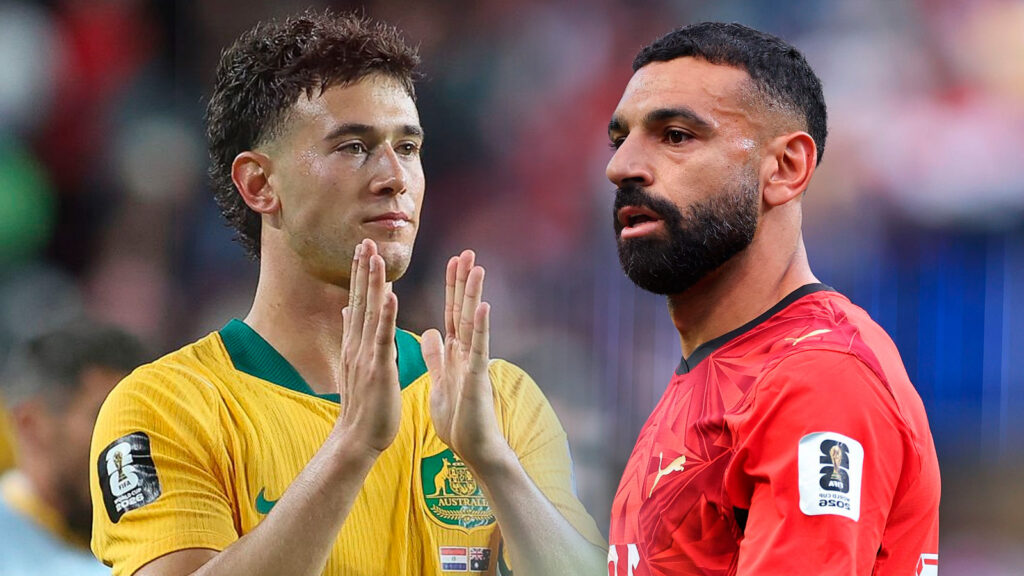
Australia and Egypt meet in Dallas for a place in the Round of 16 of the 2026 FIFA World Cup, with both nations aiming to continue impressive campaigns that have already exceeded expectations in different ways. While Egypt enter the contest as slight favourites, the margins between the two sides are slim, setting up what could be one of the closest knockout ties of the tournament.
Egypt’s preparations have been overshadowed by concerns surrounding captain Mohamed Salah. The experienced forward suffered a hamstring strain during the Pharaohs’ 1-1 draw with Iran in their final group-stage match and has since been following an individual rehabilitation programme. His availability remains uncertain, and his absence would represent a major setback for Egypt given his influence throughout the tournament.
Salah has been at the heart of Egypt’s attacking play, creating 11 chances during the group stage—more than every player at the tournament except Belgium’s Leandro Trossard. He also scored in Egypt’s 3-1 victory over New Zealand, a result that secured the country’s first-ever World Cup win. However, a draw against Iran, combined with Belgium’s superior goal difference, meant Egypt finished second in Group G despite remaining unbeaten.
Regardless of whether Salah features, Egypt arrive with confidence after recording the longest unbeaten run in their World Cup history. They collected five points from three matches and matched the total number of goals they had scored across their previous seven World Cup appearances, highlighting the progress they have made under pressure.
Australia, meanwhile, reached the knockout rounds through a different route. The Socceroos opened their campaign with an impressive 2-0 victory over Türkiye but struggled to maintain that momentum, suffering a defeat to the United States before playing out a goalless draw against Paraguay. Those results were still enough to secure second place in Group D and another appearance in the World Cup knockout stage.
Despite qualifying, Australia’s attacking numbers have raised concerns. They managed only 26 shots across the group stage, one of the lowest totals among teams to progress, while generating just 2.1 expected goals. Across their final two matches, Tony Popovic’s side failed to score despite registering 17 attempts, underlining their difficulties in the final third.
Striker Tete Yengi remains confident those issues can be corrected when it matters most. With the knockout rounds leaving no room for error, Australia know they must rediscover their finishing touch if they hope to extend their tournament.
While goals have been difficult to come by, Australia’s defensive structure has been among the competition’s strongest. The average expected-goal value of the shots they have allowed is among the lowest at the tournament, demonstrating how effectively they limit opponents to low-quality opportunities. Only Spain have conceded chances of a lower average quality during the group stage.
Both teams must also contend with injury concerns. Australia are already without experienced midfielder Mathew Leckie and defender Jacob Italiano after both suffered tournament-ending injuries. Egypt are expected to miss Ahmed Fatouh due to a hamstring tear, while defender Mohamed Abdelmonem also faces a race against time to recover from an ankle problem.
Previous meetings between the two nations have been rare. Australia defeated Egypt on penalties after a goalless draw in the 1987 President’s Cup, while Egypt claimed a comfortable 3-0 victory in their most recent encounter, an international friendly played in 2010. Several members of Australia’s current squad will also remember their disappointing 2-0 defeat to Egypt at the Tokyo Olympic Games.
History offers encouragement for the Socceroos. They remain unbeaten against African opposition at the FIFA World Cup, drawing with Ghana in 2010 before defeating Tunisia 1-0 during the 2022 tournament. Egypt, meanwhile, have only previously faced one Oceania nation at the World Cup, defeating New Zealand during this year’s group stage, although Australia now compete under the Asian Football Confederation.
The winner of this contest is likely to earn a daunting Round of 16 meeting with defending champions Argentina, provided Lionel Scaloni’s side avoid an upset against tournament debutants Cape Verde.
Statistical projections suggest this is the most evenly balanced fixture of the Round of 32. According to the Opta supercomputer, Egypt win 39.7 percent of pre-match simulations, while Australia emerge victorious in 28.4 percent. A draw after 90 minutes occurs in 31.9 percent of the simulations, highlighting just how competitive the matchup is expected to be.
When extra time and penalties are included, Egypt’s overall probability of progressing rises to 55.8 percent, leaving Australia with a respectable 44.2 percent chance of reaching the next round.
With Egypt hoping Salah can recover in time to inspire the team and Australia relying on their disciplined defensive approach, Dallas is set to host one of the most intriguing knockout matches of the tournament. Fine margins are likely to decide the outcome, and a single moment of quality could prove enough to send either nation into the last 16.
Should we send you latest update about your favourite sports and team?
Enter you email in the box below and hit the subscribe button to join our teaming 876+ sports community.


