


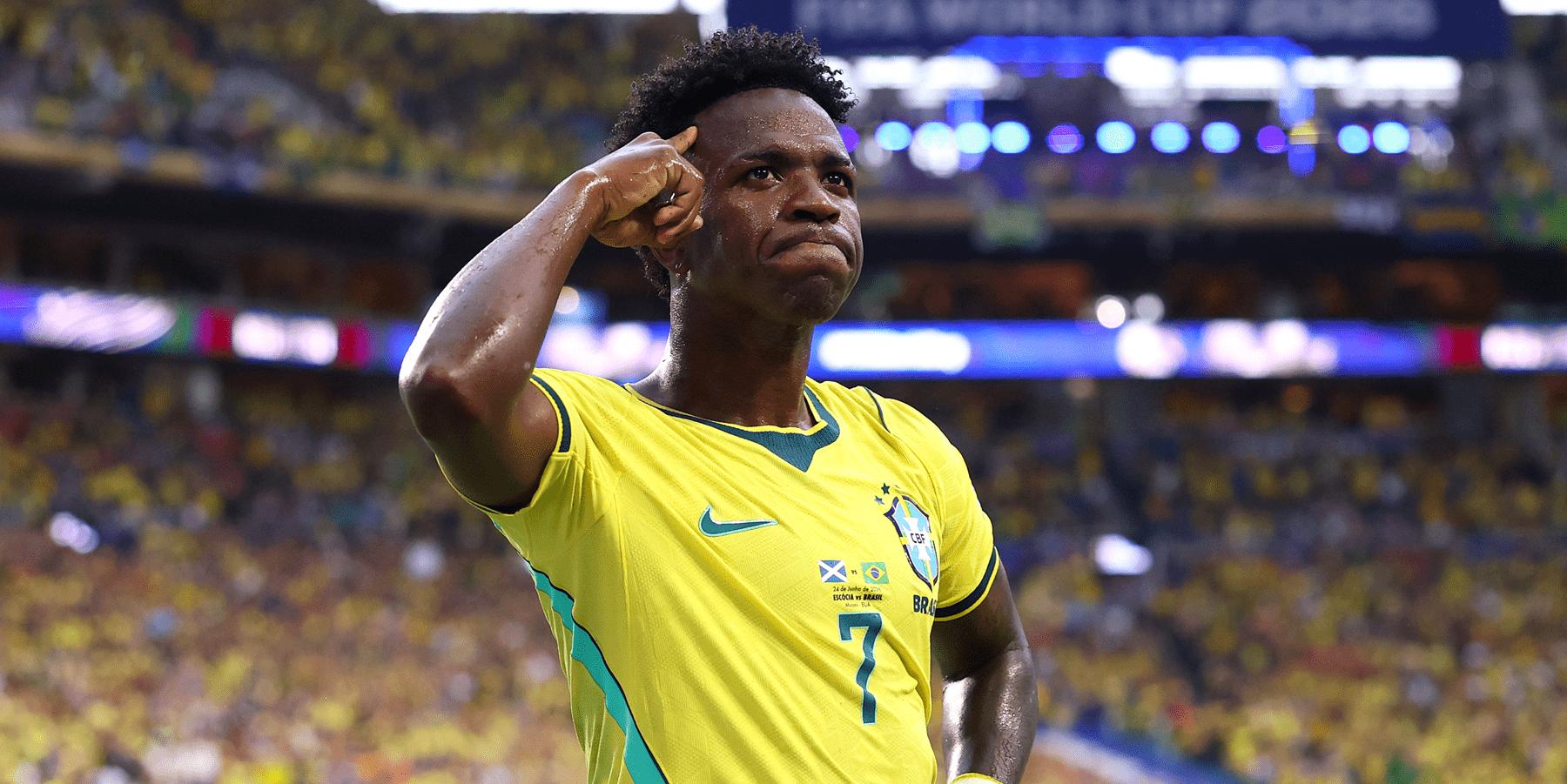
For years, Vinícius Júnior has been one of the most devastating players in club football. Week after week, he dazzled for Real Madrid, won major trophies and established himself among the world’s elite. Yet whenever he pulled on the famous yellow shirt of Brazil, the same question kept resurfacing: why couldn’t he replicate that form for the Seleção?
At the 2026 FIFA World Cup, that narrative is finally changing.
Four goals and one assist in four matches have transformed Vinícius from one of Brazil’s most scrutinised players into one of the tournament’s brightest stars. As Carlo Ancelotti’s side prepare for a Round of 16 clash against Norway, the 26-year-old has emerged as the driving force behind Brazil’s quest for a record-extending sixth World Cup title.
The turnaround has been remarkable considering the weight of expectation that has followed him throughout his career.
Vinícius was destined for stardom from the moment he burst through Flamengo’s academy. His immense potential convinced Real Madrid to agree a £38 million deal for the winger before he had even turned 18, making him one of the most expensive teenage footballers in history at the time.
The investment quickly proved worthwhile.
Since arriving in Spain, Vinícius has developed into one of Real Madrid’s defining players. Across 242 La Liga appearances, he has registered 77 goals and 41 assists, averaging 0.64 goal contributions every 90 minutes.
His success has been reflected in the club’s trophy haul. Three La Liga titles, two Copa del Rey triumphs and two UEFA Champions League crowns have cemented his legacy in Madrid, while decisive goals in Champions League finals against Liverpool and Borussia Dortmund showcased his ability to deliver on football’s biggest stage.
His performances even brought him within touching distance of the 2024 Ballon d’Or before Manchester City’s Rodri edged him to the prestigious award.
Yet despite conquering Europe, international football remained an entirely different story.
Brazilian supporters repeatedly questioned why the explosive winger looked so much less influential for the national team than he did for Real Madrid. Four years after Brazil’s painful quarter-final exit to Croatia at the 2022 World Cup, doubts still lingered over whether Vinícius could truly become the face of the Seleção.
Brazilian football expert Marcus Alves summed up the mood perfectly.
“The expectation was for him, by now, to have become the Seleção’s leading figure,” Alves observed.
“Yet, four years on from a penalty-shootout exit against Croatia in the 2022 World Cup quarter-finals, doubts remain around him.”
Former Brazil international Fábio Luciano was equally critical, arguing that Vinícius often tried to shoulder responsibilities that once belonged to Neymar.
“There is a problem with Vini, because unfortunately, when Neymar is not there, he thinks he has to be Neymar,” Luciano said.
“I think it’s too much responsibility for him. He has to take that weight off his shoulders. The national team has to take that weight off his shoulders. You are not Neymar. You’re not going to solve everything by yourself.”
The statistics supported those concerns.
Vinícius needed 19 international appearances before scoring his first goal for Brazil, eventually breaking his duck against Chile in a 2022 World Cup qualifier.
Across the 2021 Copa América, the 2022 World Cup and the 2024 Copa América, he managed only three goals and two assists in 617 minutes of tournament football.
Even outside major competitions, his production fell below expectations. Before arriving at the 2026 World Cup, he had produced a goal involvement only once every two international appearances, while averaging 2.5 shot involvements and 1.5 chances created per 90 minutes.
This summer, however, almost every attacking metric has improved dramatically.
Vinícius has scored four goals and supplied one assist in Brazil’s opening four matches, placing him firmly among the favourites for the Golden Boot. Only Kylian Mbappé and Lionel Messi, with six goals each, alongside Erling Haaland and Harry Kane with five apiece, have scored more.
More importantly, the underlying numbers suggest his performances are no fluke.
Few players in world football are as dangerous carrying the ball at speed, and that trademark strength has once again become Brazil’s greatest attacking weapon.
Since joining Real Madrid in 2018, only Mbappé has recorded more shot involvements following a ball carry across Europe’s top five leagues. Mbappé has produced 462 shot involvements and 80 goal involvements after carries, while Vinícius has registered 441 shot involvements and 56 goal involvements.
In the UEFA Champions League, Vinícius actually tops both categories, highlighting how devastating he becomes once he accelerates into space.
That ability has been on full display throughout this World Cup.
He shares the tournament lead for carries ending in a shot with nine, level alongside Spain sensation Lamine Yamal. Two of those carries have resulted directly in goals, with only France’s Ousmane Dembélé producing more.
No player has also carried the ball into the opposition penalty area more frequently than Vinícius, who has already done so 18 times.
The quality of his finishing opportunities reflects that constant attacking threat.
According to Opta’s data, Vinícius has generated the highest expected goals (xG) total of any player at the tournament with 3.87 while also recording the second-most shots on target with 10.
Rather than relying on speculative efforts, Brazil’s star winger is consistently creating high-quality scoring opportunities through his intelligent movement and relentless direct running.
Those improvements have coincided with Brazil’s steady progress through the tournament.
Carlo Ancelotti’s side now face Norway in the Round of 16, where Erling Haaland presents perhaps their toughest challenge yet. Opta’s supercomputer gives Brazil a 64.7 per cent chance of progressing to the quarter-finals and currently rates them as having a 9.1 per cent probability of lifting the World Cup trophy.
If Brazil are to fulfil that prediction, much of the responsibility will rest on Vinícius’ shoulders.
Unlike previous tournaments, though, that burden no longer appears too heavy to carry.
Instead of trying to replace Neymar or live up to impossible comparisons, Vinícius is finally carving out his own identity in Brazil colours.
The criticism that followed him for years is gradually fading, replaced by performances worthy of one of football’s biggest stages.
For a player who conquered Europe long ago, the 2026 World Cup may finally be the tournament that allows him to conquer Brazil’s hearts as well.
Should we send you latest update about your favourite sports and team?
Enter you email in the box below and hit the subscribe button to join our teaming 876+ sports community.


