


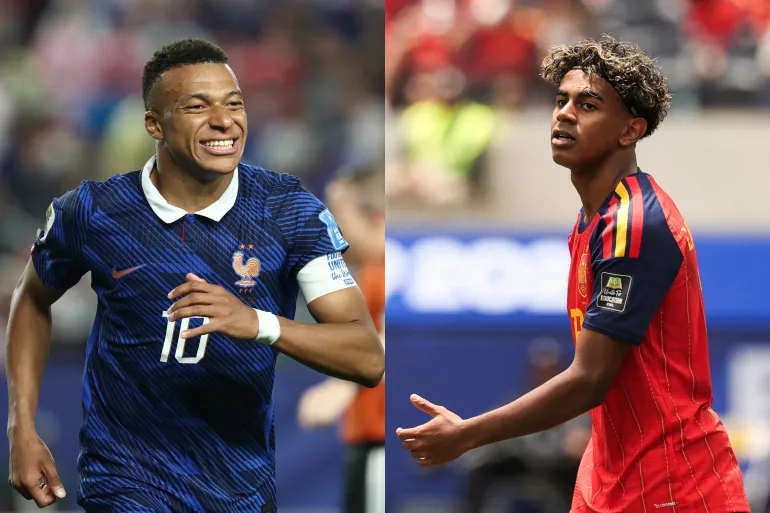
France’s free-scoring attack will come up against Spain’s rock-solid defence when the two European heavyweights meet in the first semi-final of the 2026 FIFA World Cup on Tuesday in Dallas, in what promises to be one of the tournament’s defining encounters.
According to Opta’s supercomputer, the winner of the clash will become the favourite to lift the World Cup trophy, with both France and Spain given a higher probability of winning the tournament than the other semi-finalists, England and Argentina. While both teams have reached the last four in impressive fashion, they have done so using contrasting approaches that set up a fascinating tactical battle.
Spain have built their campaign on exceptional defensive discipline under head coach Luis de la Fuente. Although they have maintained their trademark possession-based style, averaging 66 percent possession per game and completing 598 passes per match, their biggest strength has been without the ball. Through six matches, La Roja have faced just seven shots on target, averaging only 1.17 per game, the best defensive record of any men’s World Cup team since records began in 1966.
Their ability to limit clear-cut opportunities has been equally remarkable. Spain have conceded only 0.31 expected goals (xG) per match throughout the tournament, matching one of the best defensive records in World Cup history. The average quality of chances allowed against them has been just 0.05 xG per shot, highlighting how effectively they have prevented opponents from creating dangerous opportunities.
Several players have been central to Spain’s defensive success. Veteran centre-back Aymeric Laporte has produced 11 interceptions, the second-highest total at the tournament, while goalkeeper Unai Simón has excelled as a sweeper behind Spain’s high defensive line. Captain Rodri has also returned to his influential best after recovering from an anterior cruciate ligament injury, ranking among the tournament leaders for tackles and ball recoveries. The consistency of Spain’s back line has also been a major factor, with Simón, Laporte, Pau Cubarsí and Marc Cucurella starting every match.
France, meanwhile, have relied on arguably the most dangerous attack at the World Cup. Didier Deschamps’ side have scored 16 goals in six matches while producing the competition’s highest expected goals tally at 14.3 xG. They have also registered 47 shots on target, the highest figure recorded by France at a World Cup since their victorious 1998 campaign and the highest shots-on-target average of any team in the modern era of the tournament.
Leading France’s attack is captain Kylian Mbappé, who has enjoyed another outstanding World Cup campaign. The forward has scored eight goals to put himself firmly in contention for the Golden Boot while also contributing creatively with three assists and 16 chances created. Alongside him, Ballon d’Or holder Ousmane Dembélé has added five goals and two assists, with the pair developing one of the tournament’s most productive attacking partnerships by creating 19 chances for each other.
Michael Olise has also emerged as one of France’s standout performers. The Bayern Munich winger leads the tournament assist chart with five and has become the first player since Germany’s Thomas Häßler in 1994 to reach that mark at a single World Cup. One more assist would see him equal Pelé’s long-standing record for the most assists at a men’s World Cup since 1966.
France’s attacking depth provides Deschamps with even more options, with Bradley Barcola, Désiré Doué, Rayan Cherki, Maghnes Akliouche and Marcus Thuram all available to influence games from the bench. That wealth of talent has allowed Les Bleus to maintain their attacking threat throughout the tournament.
Tuesday’s semi-final therefore presents a classic battle between the tournament’s most prolific attack and its most resilient defence. Whether France’s array of attacking stars can finally breach Spain’s disciplined back line could determine not only who reaches the World Cup final, but also who ultimately goes on to lift the trophy.
Should we send you latest update about your favourite sports and team?
Enter you email in the box below and hit the subscribe button to join our teaming 876+ sports community.


